

Every Generation Improves Period Care. What Will Ours Be Remembered For?
There was a time when menstruation wasn’t discussed openly. There was a time when menstrual hygiene awareness was limited.
There was a time when many women relied on cloth as their primary menstrual care solution because there were few alternatives available.
Then came one of the most important innovations in women’s health disposable sanitary pads. Pads brought convenience, accessibility, and improved menstrual hygiene to millions of women around the world. They helped women attend school, go to work, travel comfortably, and manage their periods with greater confidence.
There is no denying the positive impact sanitary pads have created.
In fact, even today, governments, NGOs, healthcare professionals, and CSR initiatives continue to work tirelessly to improve access to menstrual hygiene products and awareness.
And rightly so.
Because every woman deserves safe and dignified period care. But every solution that solves one challenge often introduces a new one. And that brings us to an important question.
What Happens After We Throw It Away?
Most of us never think about our menstrual products after disposal.
Why would we?
Once it’s in the bin, the job is done.
Or is it?
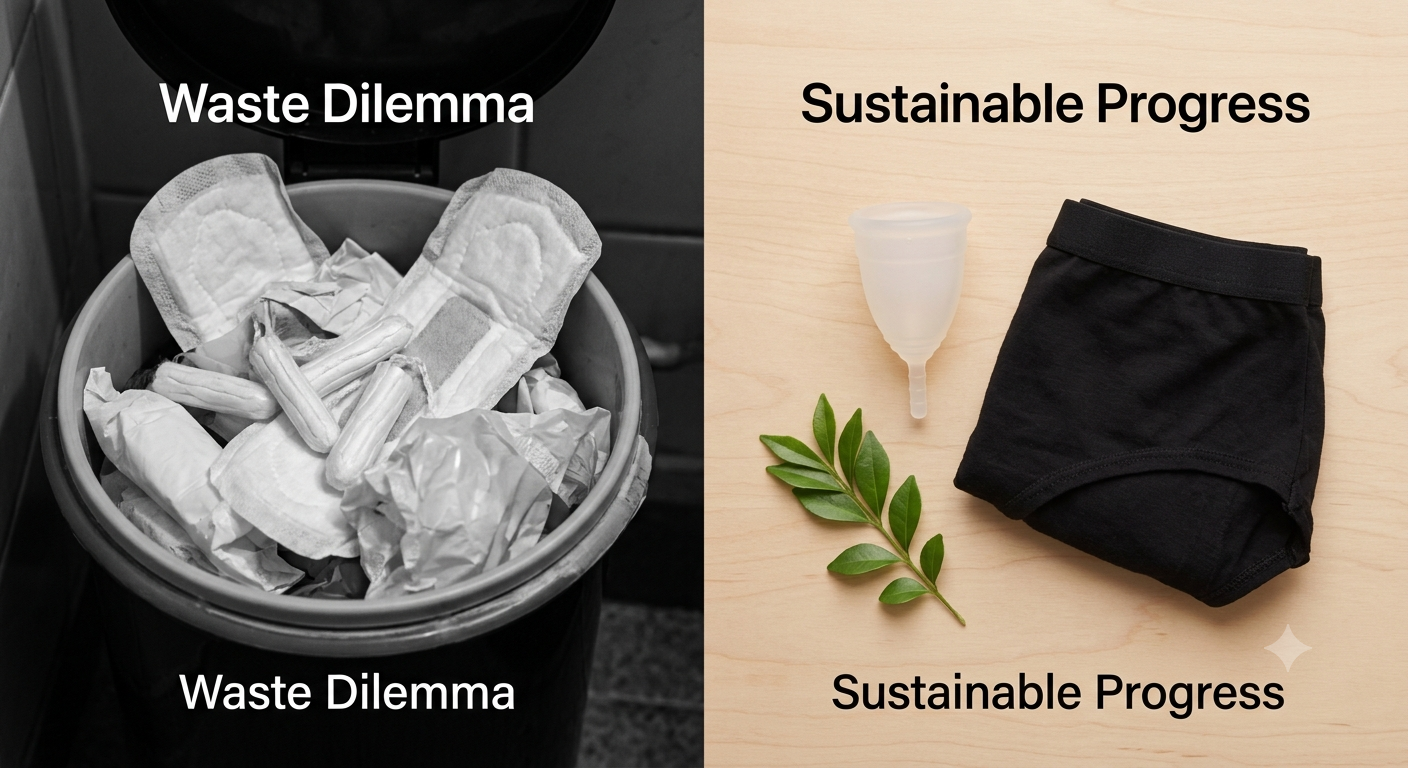
The reality is that millions of disposable menstrual products are discarded every single day across the world. Many of these products contain plastic-based materials that can take decades—or even centuries—to break down completely.
A pad may be used for a few hours. Its environmental impact can remain for generations. This is not about blaming women. Nor is it about criticizing disposable pads. Pads solved a major problem in menstrual hygiene. But as awareness around sustainability grows, society is beginning to ask a new question:
Can period care be both comfortable and environmentally responsible?
The Next Evolution of Period Care
If we look back, menstrual care has constantly evolved.
From cloth to disposable pads.
From silence to awareness.
From stigma to open conversations.
Today, we are witnessing another shift. Not because existing solutions are wrong. But because women deserve more choices. Choices that suit different lifestyles. Different comfort levels. Different priorities.
And increasingly, choices that are kinder to the environment.
This is where reusable menstrual products have started changing the conversation.
Pads Changed Menstrual Hygiene. Reusable Products Are Changing Menstrual Sustainability.
A powerful shift is taking place. Women are no longer only asking:
“What is comfortable for me?”
They are also asking:
“What impact does my choice create?”
And that’s a question worth celebrating.
Because awareness is progress.
Why We Started This Journey at Imasafe
When Jigisha Gandhi founded Imasafe in 2019, sustainability was never viewed as a trend.
It was viewed as a responsibility. As someone deeply passionate about women’s health and hygiene, she believed that innovation should improve lives without creating unnecessary burden on the environment. This vision inspired the development of sustainable menstrual care solutions designed around one simple idea:
Better choices create a better future.
At Imasafe, we are working towards that future by providing women with high-quality reusable menstrual products that support both personal well-being and environmental responsibility.
One Solution Doesn’t Fit Everyone—And That’s Okay
Let’s acknowledge something important. Not every woman will choose a menstrual cup. And that’s perfectly okay. One of the biggest reasons many women hesitate to try menstrual cups is uncertainty.
Will it be comfortable?
Will insertion feel difficult?
Will it be painful?
Is it safe?
These concerns are completely natural, especially in a country where intimate health conversations have traditionally been limited. Every woman’s comfort level is different. Every menstrual journey is different. The goal should never be to force a particular choice.
The goal should be to offer informed choices.
For Women Ready to Switch: The Menstrual Cup
For women looking for a long-term reusable solution, the Imasafe Menstrual Cup offers an alternative designed for comfort, reliability, and sustainability.
Manufactured in-house using medical-grade silicone at Ami Polymer Pvt. Ltd., it can be reused for years with proper care.
One product.
Years of use.
Significantly less menstrual waste.
For many women, it represents freedom, convenience, and confidence. But we understand that this option may not feel right for everyone. Which is why sustainability cannot stop at one product.
For Women Who Prefer Pads: The Reusable Period Panty
Many women are comfortable with the experience of using pads. They appreciate the familiarity.
The simplicity.
The ease of use.
For this segment, reusable period panties provide another sustainable alternative. Designed to be worn just like regular underwear, period panties offer comfort, absorbency, and convenience while reducing dependence on disposable products.
They require no insertion.
No learning curve.
No major change in routine.
Just a different approach to period care—one that can be washed, reused, and worn again. Because sustainability should be accessible, not intimidating.
The Real Goal Isn’t a Product. It’s Progress.
At Imasafe, we don’t believe sustainability should be limited to a single solution. We believe in creating options. Options that empower women to choose what works best for their bodies, lifestyles, and comfort levels.
Whether it’s a menstrual cup.
A reusable period panty.
Or future innovations yet to come.
Our mission remains the same:
To help women make informed choices while reducing the environmental impact of period care.
What Will Our Generation Be Remembered For?
Our grandmothers improved menstrual care through resilience. Our mothers improved menstrual care through accessibility and awareness. Perhaps our generation has an opportunity to improve menstrual care through sustainability. Not by rejecting the past. Not by judging existing choices. But by building on the progress that came before us.
Because every generation improves period care.
The question is:
What will ours be remembered for?